Welcome to Spogen Pvt Ltd — OEM Sports Goods Manufacturing Since Sialkot's Earliest Export Era
Choosing the right Bulk Team Duffel Bags requires more than comparing colors, logos, and quoted prices. Global buyers need dependable construction, clear specifications, and practical shipping plans. A bag may look strong online, yet fail when wet uniforms, shoes, and equipment fill every compartment.
Sports-equipment sourcing consultant David J. Harrington explains, “A team bag must survive the routine, not merely impress in a sample photograph.” That observation matters. Buyers should examine fabric density, reinforced handles, zipper quality, shoulder-strap stitching, and base-panel protection. Small details often decide whether a bag lasts one season or several.
This guide introduces the leading Bulk Team Duffel Bags for international purchasing teams. It considers capacity, customization, minimum order quantities, sample approval, packaging, and supplier communication. It also addresses practical concerns, including odor control, color consistency, carton efficiency, and delivery coordination. These factors can influence the real landed cost.
Performance matters most.
Still, no buying guide is perfect. Product quality can change between samples and mass production. Supplier promises can also sound better than their inspection records. Buyers should request current material details, production photos, and independent quality checks when appropriate. A low price may hide thinner fabric or weaker hardware. That possibility deserves attention.
For clubs, schools, academies, and corporate teams, the best choice balances durability, appearance, budget, and reliable replenishment. The following overview helps global buyers compare options with greater confidence and fewer surprises.
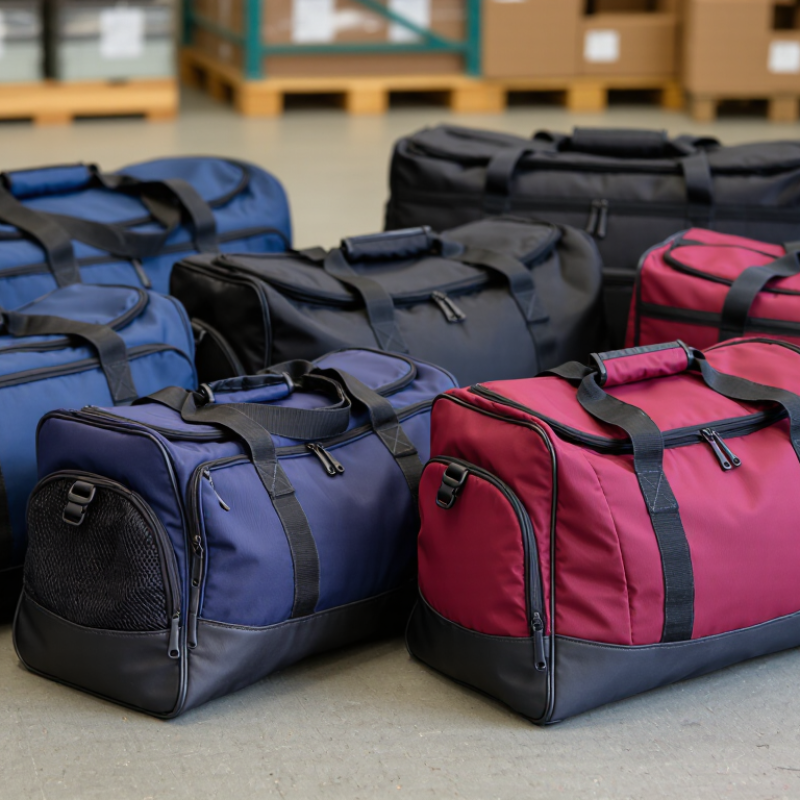
For global buyers, a high-quality bulk team duffel bag begins with dependable construction, not flashy decoration. A dense polyester or recycled fabric should resist abrasion from locker floors, bus storage, and repeated loading. Inspect seams closely. Double stitching at handles matters because shoulder straps carry uneven weight during travel. A reinforced base, smooth zippers, and bar-tacked stress points reduce common failures. The bag should also stand upright when partly filled, making team distribution faster.
Capacity must match real team routines. Separate compartments can hold footwear, damp clothing, documents, and small equipment without mixing everything. Ventilation is helpful, but oversized mesh panels may weaken the structure. Measure the finished bag, including handles and wheels if included. Samples should be filled with realistic weight, carried, opened, and inspected after several cycles. Ask for material details, stitching specifications, colorfastness results, and dimensional tolerances. Reliable suppliers should answer clearly and provide consistent pre-production samples. Cheap often becomes expensive when replacements disrupt a tournament schedule. This might sound obvious.
Tips: Request one sample from the planned production batch, not only a showroom piece. Check zipper alignment, odor, lining, handle comfort, and logo placement. Photograph defects before approval. Keep a written inspection checklist. Even strong designs need revision; a heavy bag may survive well but exhaust younger players. That trade-off deserves honest testing. Buyers should confirm packaging dimensions and shipping weight before ordering. Small measurement errors can affect warehouse charges and storage space. A measurement sheet often reveals more than a confident sales description.
For global bulk buyers, compare materials before colors or logos. The Textile Exchange 2024 Materials Market Report estimates global fiber production reached 124 million tonnes in 2023. Polyester represented 57% of that volume. 600D recycled polyester offers abrasion resistance and consistent sourcing. Nylon can feel tougher, but usually costs more. Cotton canvas gives a premium handfeel, yet absorbs moisture and adds weight. Check coating thickness, tear strength, and water resistance. A shiny finish proves little. In my sourcing experience, samples often outperform specification sheets—or fail at the zipper.
Size should match the team’s real use. A 30–40 liter bag suits short trips. A 50–70 liter model fits uniforms and basic equipment. Larger 80-liter bags need stronger handles and base panels. However, volume claims vary. Request measured internal capacity, not only external dimensions. Compare U-shaped openings, reinforced webbing, bartack stitching, padded handles, and replaceable shoulder straps. The International Air Transport Association’s 2024 baggage guidance stresses carrier-specific cabin limits. A large duffel may not qualify as carry-on. One weak stress point can damage an entire shipment.
Tips: Request samples from three production lots. Weigh each bag. Fill them with towels. Drag them across concrete. Record zipper cycles, handle stretch, odor, and color transfer. Require pre-shipment inspection with agreed tolerances. Verify recycled-content claims through supplier documents or third-party testing. Sustainability claims can be incomplete. That deserves scrutiny.
| Duffel Type | Common Main Fabric | Typical Dimensions (L × W × H) |
Approx. Capacity |
Typical Empty Weight |
Construction Features to Compare | Hardware and Closure Options | Typical Team or Bulk-Order Application |
|---|---|---|---|---|---|---|---|
| Entry-Level Standard Duffel |
600D polyester with a polyurethane coating
Cost-efficient Lightweight |
55 × 28 × 28 cm | 40–45 L | 0.55–0.80 kg | Single main compartment, bound interior seams, reinforced webbing at handle attachment points, and a padded or unpadded shoulder strap. | No. 5 or No. 8 coil zipper, plastic side-release buckles, and zinc-alloy or plastic strap adjusters. | School teams, promotional programs, short tournaments, and price-sensitive bulk orders. |
| Mid-Range Team Duffel |
600D–900D polyester, often with a water-resistant backing
Balanced durability |
60 × 30 × 30 cm | 50–55 L | 0.75–1.10 kg | Separate ventilated shoe compartment, double-layer base, padded carry handles, bartack reinforcement, and internal organizer pockets. | No. 8 coil or molded zipper, reinforced zipper pulls, webbing compression straps, and durable metal or acetal-plastic hardware. | Regular team travel, sports clubs, uniform issue programs, and recurring institutional orders. |
| Heavy-Duty Team Duffel |
900D–1200D polyester or nylon with abrasion-resistant coating
High abrasion resistance |
65 × 32 × 32 cm | 60–70 L | 1.00–1.50 kg | Heavy-duty base panels, multi-layer reinforcement under the handles, padded end panels, wide webbing, and stress-point bartacks. | No. 8 or No. 10 zipper, metal D-rings, reinforced metal sliders, and adjustable padded shoulder strap. | Frequent travel, outdoor sports, equipment transport, and teams requiring longer product service life. |
| Convertible Backpack Duffel |
600D–900D polyester or recycled polyester
Multiple carry modes |
55 × 30 × 28 cm | 40–50 L | 0.85–1.30 kg | Stowable backpack straps, padded back panel, reinforced shoulder-strap anchors, structured opening, and compartmentalized interior. | Lockable-compatible main zipper, padded strap adjusters, side compression straps, and covered buckles. | Athletes moving between venues, travel-heavy teams, and buyers seeking one bag for hand carry and backpack use. |
| Water-Resistant Competition Duffel |
Coated 500D–900D polyester or nylon with sealed or water-resistant fabric construction
Weather protection |
58 × 30 × 30 cm | 45–55 L | 0.90–1.40 kg | Water-resistant base, covered zipper area, reinforced seam binding, drainage eyelets where appropriate, and a separate wet-item pocket. | Water-resistant coil zipper, coated webbing, corrosion-resistant metal components, and protective zipper garages. | Outdoor competitions, rainy climates, field sports, and travel programs exposed to changing weather. |
| Equipment and Ball Duffel |
600D–1000D polyester with abrasion-resistant bottom fabric
High volume |
75 × 35 × 35 cm | 80–95 L | 1.20–1.90 kg | Wide rectangular opening, reinforced floor, multiple grab handles, internal divider, mesh ventilation panels, and high-load webbing. | No. 10 zipper, heavy-duty webbing loops, reinforced seams, and optional wheeled base or trolley sleeve. | Shared team equipment, balls, protective gear, uniforms, and coach-managed transport. |
| Wheeled Team Duffel |
600D–1200D polyester or nylon with a reinforced molded base
Reduced carrying load |
70 × 35 × 35 cm | 75–90 L | 2.50–4.00 kg | Telescopic handle housing, protected wheel wells, rigid or semi-rigid base, reinforced pull zones, and balanced internal load distribution. | Inline or corner wheels, telescopic handle, No. 10 zipper, protective corner panels, and metal or reinforced polymer fittings. | Large equipment loads, airports, long-distance tournaments, and users prioritizing mobility over minimum bag weight. |
| Sustainable Material Duffel |
Recycled polyester, commonly 600D–900D, with recycled-content documentation requested during sourcing
Lower virgin-fiber use |
55–65 × 28–32 × 28–32 cm | 40–70 L | 0.70–1.30 kg | Construction can match conventional polyester models; buyers should compare recycled content, coating chemistry, seam strength, and colorfastness. | Recycled or standard polyester webbing, coil zippers, low-profile hardware, and optional recycled trims depending on the specification. | Sustainability-led team programs, institutional procurement, event merchandise, and buyers requiring environmental documentation. |
Specification ranges are typical industry planning values rather than fixed product standards. Final bulk-order comparisons should confirm fabric denier, coating type, seam strength, zipper size, test methods, carton dimensions, and maximum load with the manufacturer.
Top Bulk Team Duffel Bags for Global Buyers
Team duffel bags should match the activity, not just the logo. For daily training, choose medium-sized bags with ventilated shoe compartments and reinforced handles. A 40–60 liter design usually holds uniforms, towels, and personal gear without becoming awkward. For tournaments, larger wheeled duffels reduce carrying strain across airports and sports venues. However, wheels add weight and may fail on rough ground. A simpler shoulder duffel can be more reliable for short trips.
Different travel needs require different materials and layouts. Water-resistant polyester suits frequent transport and changing weather. Heavy-duty fabric helps teams that load bags into vans repeatedly. Internal mesh pockets keep documents, chargers, and small medical supplies visible. Wide openings also help staff inspect contents quickly. In bulk purchasing, check zipper strength, seam stitching, handle attachment, and sample measurements before approving production. Color consistency can be difficult across large orders, especially between fabric batches. It deserves a written quality standard.
Tips: Request one sample in every planned size. Test it with real uniforms, shoes, and bottles. Confirm carton dimensions before shipping, because oversized packaging can raise freight costs. Ask for care instructions and replacement-part availability. Do not choose the cheapest fabric automatically. It may save money briefly, then create replacement problems.
Global buyers should evaluate suppliers before comparing logo colors or low quotes. Grand View Research valued the global luggage market at USD 22.37 billion in 2023. It also projects steady growth through 2030. This demand attracts both capable factories and inexperienced resellers. Ask for factory photographs, audit records, material specifications, and recent production samples. A polished catalog proves very little.
For team duffel bags, inspect 600D polyester density, stitching around handles, zipper strength, and base-panel abrasion. Request a sample with realistic weight inside. Measure the bag after packing it, not while empty.
Customization needs equal attention. Confirm embroidery size, print method, color tolerance, carton marks, and packaging details in writing. The International Trade Centre highlights accurate product information as important for smoother cross-border trade. Small errors can delay an entire shipment. I have seen buyers focus on artwork while ignoring handle reinforcement. That is an expensive lesson.
Tips: Compare at least three suppliers using the same specification sheet. Ask for a pre-production sample before approving bulk production. Confirm minimum order quantities and lead times separately for each color. Check whether replacement parts are available. Do not assume “custom” means unlimited changes. A supplier may accept a design but lack the equipment to produce it consistently. Allow time for one correction cycle, because first samples are rarely perfect.
Buying team duffel bags in bulk requires more than comparing unit prices. Define capacity, fabric weight, stitching patterns, handle length, zipper type, and logo placement before requesting quotations. A clear specification sheet prevents costly interpretation gaps across languages and time zones. Ask suppliers for a physical sample, not only studio images. Check the bag when fully loaded. Does the shoulder strap twist? Can the base stand on a warehouse floor? Small faults become expensive at scale.
Request a pre-production sample with the final materials and decoration. Inspect seam strength, bartacks, lining, zipper movement, odor, color consistency, and carton packing. An independent inspection can verify dimensions, quantity, workmanship, and random samples before release. Use an agreed tolerance, such as a small measurement range, rather than vague words like “premium.” Keep dated photos and signed inspection records. They support fair decisions if quality differs from the approved sample. Still, inspection is not magic. It can miss damage caused by rough transit.
For international delivery, compare sea, air, and rail options using total landed cost. Include freight, insurance, handling, duties, taxes, and destination storage. Confirm the shipping term, delivery address, carton dimensions, and document responsibilities in writing. Use moisture protection and strong cartons for long routes. Ask for a loading report and tracking details. Build buffer time around holidays and port congestion. A common planning mistake is allowing no space for rework. That delay can affect warehouse schedules and product launches.
Recycled polyester offers abrasion resistance and steady sourcing. Nylon feels tougher, but usually costs more. Cotton canvas feels premium, yet absorbs moisture and adds weight. Check coating thickness, tear strength, and water resistance. A glossy surface proves little.
A 30–40 liter bag fits short trips. A 50–70 liter model holds uniforms and basic equipment. Bags above 80 liters need stronger handles and base panels. Measure internal capacity, not only outside dimensions. Volume claims can be surprisingly inconsistent.
Check U-shaped openings, reinforced webbing, bartack stitching, and padded handles. Inspect zipper movement and handle attachment points. Replaceable shoulder straps may reduce future waste. One weak stress point can damage the whole shipment. Small details matter.
Wheeled designs reduce carrying strain across airports and sports venues. They add weight and may fail on rough ground. Simple shoulder duffels can be more reliable for short trips. Choose based on real routes, not appearance.
Request samples from three production lots. Weigh each bag and fill it with towels. Drag it across concrete. Record zipper cycles, handle stretch, odor, and color transfer. Test real uniforms, shoes, and bottles. Studio photos are not enough.
Define capacity, fabric weight, stitching patterns, handle length, zipper type, and decoration placement. Include acceptable measurement tolerances. State color requirements in writing. Vague terms like “premium” create disputes. I might still miss a hidden weakness.
Request supplier documents supporting recycled-content claims. Third-party testing can provide additional evidence. Compare the documents with the final materials. Sustainability statements may be incomplete. That deserves careful questioning.
Compare sea, air, and rail using total landed cost. Include freight, insurance, handling, duties, taxes, and storage. Confirm delivery terms and document responsibilities in writing. Use moisture protection and strong cartons. Allow time for rework and port delays. Planning too tightly often causes trouble.
Choosing the right Bulk Team Duffel Bags requires a careful review of quality, function, and supplier reliability. High-quality bags should use durable, water-resistant materials, reinforced stitching, strong zippers, comfortable handles, and adjustable shoulder straps. Buyers should compare sizes, compartment layouts, load capacity, and construction details to match different team sports, group travel, training, and event needs. Options may include compact personal duffels, large shared equipment bags, wheeled designs, and multi-compartment travel styles.
For global buyers, supplier evaluation should include production experience, material consistency, sample approval, customization capabilities, minimum order quantities, and communication efficiency. Custom features such as colors, logos, labels, packaging, and interior organization should be confirmed through clear specifications and pre-production samples. Before placing an international order, buyers should also review lead times, payment terms, shipping arrangements, documentation, and inspection procedures. A practical quality-control plan covering measurements, stitching, hardware, printing, packing, and final quantity checks can help ensure that the finished bags meet both team requirements and international purchasing expectations.