Welcome to Spogen Pvt Ltd — OEM Sports Goods Manufacturing Since Sialkot's Earliest Export Era
Choosing a China Top Thermo Bonded Soccer Balls Supplier requires more than comparing catalog prices. The right partner should demonstrate stable manufacturing experience, technical knowledge, and dependable quality control. Thermo Bonded Soccer Balls are produced with heat and pressure, creating a seamless surface that supports consistent shape, water resistance, and flight performance.
Factory evidence matters. Ask for production photos, material specifications, sample records, and recent inspection reports. A reliable supplier should explain its bladder construction, adhesive system, panel materials, and size tolerances clearly. It should also confirm compliance with recognized safety and testing requirements for international markets. Details such as machine calibration, stitching alternatives, pressure retention, and logo durability can reveal real expertise.
Small differences matter.
A serious manufacturer will usually support sample approval before bulk production. Testing should include roundness, rebound, circumference, weight, air retention, and visual finish. For match-use balls, performance may be checked on grass, artificial turf, and hard training surfaces. Customer references and export experience can strengthen confidence, but neither guarantees perfect results. Communication quality matters too. Delayed answers may signal operational weakness.
The lowest quotation can become expensive after defects, missed delivery dates, or inconsistent batches. A better evaluation considers factory capability, inspection procedures, customization flexibility, packaging, production capacity, and after-sales support. It is also wise to review contract terms carefully and verify every certificate independently. No supplier is flawless. Even experienced factories may need improvement in color matching or delivery coordination. Careful questioning helps buyers identify a dependable China Top Thermo Bonded Soccer Balls Supplier for clubs, schools, retailers, and professional training programs.
What Are Thermo Bonded Soccer Balls?
Thermo bonded soccer balls are built by sealing panels with heat, pressure, and adhesive. They do not rely mainly on stitched seams. This process can create a smoother surface and more consistent roundness. On a wet training field, fewer exposed seams may also reduce water absorption. That detail matters during long sessions.
The FIFA Quality Programme testing framework specifies a circumference of 68–70 centimetres and a weight of 410–450 grams for regulation footballs. It also checks shape retention, rebound, pressure loss, and water absorption. These figures give buyers a practical inspection baseline. However, thermo bonding alone does not guarantee a superior ball. Poor panel alignment can still affect flight. The surface may also feel too firm when the bladder or foam layer is poorly matched.
A reliable China supplier should provide test records, panel construction details, bladder material, and production samples. Ask how the ball performs after repeated impacts, not only after factory inspection. In our experience, a ball that looks perfectly round can develop slight distortion after outdoor use. That is where supplier quality control needs honest review. Request batch-level measurements, pressure retention data, and documented testing against the relevant football standard.
Thermo bonded soccer balls are made by joining their panels with heat and adhesive instead of relying mainly on thread stitching. The construction method can help create a smoother surface and reduce water entry through seams. Regardless of construction, a size 5 match ball must remain within the official circumference, weight, and pressure limits shown below.
The chart shows the relative width of each official size 5 specification range, calculated from the range width divided by its lower limit. The values are normalized because circumference, weight, and pressure use different units.
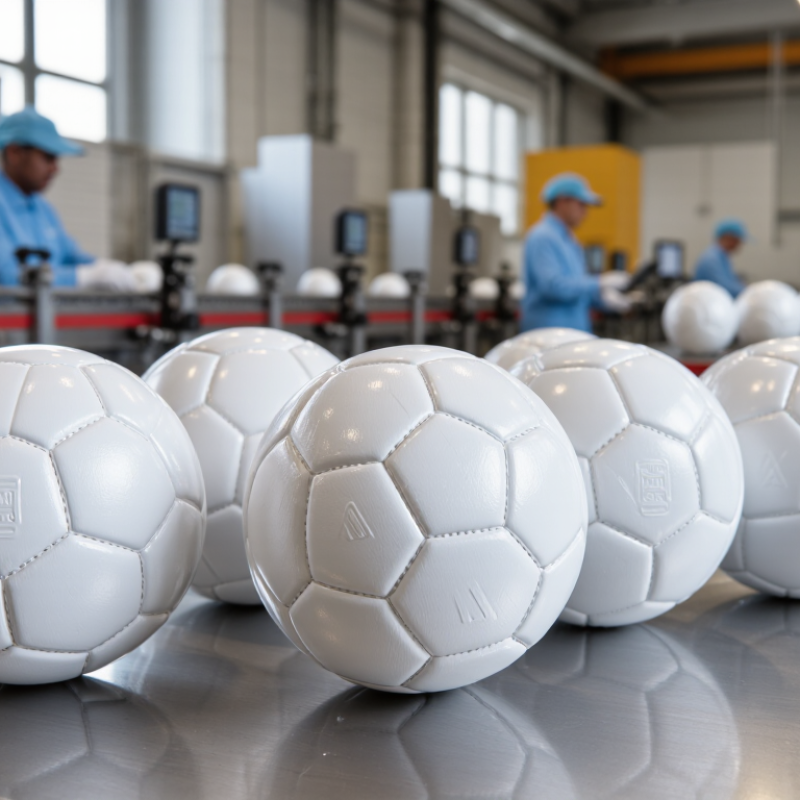
A thermo bonded soccer ball begins with carefully cut polyurethane panels. Each panel is printed, coated, and laminated with textile backing. Workers then position the panels around a rubber bladder. Heat and controlled pressure activate the adhesive, creating a nearly seamless outer shell. Heat matters.
Factory technicians monitor mold temperature, pressing time, and panel alignment. A small shift can change the ball’s roundness or flight. The ball is inflated during forming, then cooled inside the mold. This stabilizes its shape. Small wrinkles still happen, especially when material moisture is poorly controlled.
Quality inspection follows recognized football standards. The FIFA Laws of the Game specify a circumference of 68–70 centimeters, a weight of 410–450 grams, and pressure between 0.6 and 1.1 atmospheres. The FIFA Quality Programme also evaluates circumference, roundness, rebound, weight, pressure loss, water absorption, and shape retention. These seven tests give Chinese manufacturers measurable checkpoints, rather than relying only on visual inspection.
Reliable suppliers record material batches, bladder pressure, mold settings, and final test results. They should provide sample approvals and production inspection reports. A practical warning remains: a ball can pass laboratory checks yet feel different on wet grass. Field testing still matters. Thermo bonding improves consistency, but it does not remove every manufacturing variable.
A top Chinese thermo bonded soccer ball supplier proves control, not just low pricing. Thermo bonding removes many stitched seams, creating a smoother outer surface and more consistent shape. However, production quality depends on bladder alignment, panel pressure, adhesive curing, and final inspection. Small errors can cause uneven rebounds.
FIFA’s Quality Programme for Footballs specifies size 5 targets of 68.5–69.5 centimetres in circumference and 410–450 grams in weight. Its testing framework also examines rebound, water absorption, pressure loss, and shape retention. A capable supplier should share batch records, pressure-test results, and retained samples. Ask for the same ball after repeated wet and dry testing. Real evidence matters more than polished catalog photos.
China is a strong sourcing location because mature sporting-goods clusters support material access, tooling, and export coordination. The World Bank’s Logistics Performance Index 2023 shows China ranked 19th globally, with a score of 3.7 out of 5. That supports dependable international shipment planning, although delays still happen. A factory should explain lead times, carton protection, replacement procedures, and inspection responsibility in writing. No factory is flawless. A supplier that admits its weak points may be more reliable than one promising zero defects. During a factory visit, inspect bonding edges, valve placement, panel symmetry, and the smell of fresh adhesive. The details are easy to miss.
| Evaluation Dimension | Relevant Data or Specification | Why It Matters for Thermo Bonded Soccer Balls | Recommended Buyer Verification |
|---|---|---|---|
| Ball Size | Size 5: 68–70 cm circumference Size 4: 63.5–66 cm circumference Size 3: 58.5–61 cm circumference |
Correct sizing supports compliance with standard match, training, youth, and grassroots requirements. | Request dimensional inspection records for each production batch. |
| Ball Weight | Size 5: 410–450 g Size 4: 350–390 g Size 3: 300–320 g |
Weight affects handling, flight stability, kicking feel, and suitability for different age groups. | Confirm the approved weight range and require random sample weighing before shipment. |
| Inflation Pressure | Standard match-ball pressure is approximately 0.6–1.1 atmospheres at sea level, equivalent to about 8.5–15.6 psi. | A stable pressure range helps maintain predictable rebound, shape retention, and playing performance. | Check pressure-retention data after inflation and storage at the agreed pressure. |
| Construction Method | Thermo bonding joins the outer panels using controlled heat and pressure rather than relying only on traditional stitching. | Fewer exposed seams can improve surface uniformity and reduce pathways for water entry when the construction is properly controlled. | Inspect bonding lines, panel alignment, seam consistency, and bonding strength on production samples. |
| Outer Cover Material | Polyurethane (PU) is commonly used for match and training balls because it offers a soft touch and flexible surface. PVC is generally used for more economical products. | Material selection influences softness, abrasion resistance, water resistance, appearance, and cost. | Specify PU grade, surface texture, thickness, abrasion requirement, and approved color standard. |
| Panel Configuration | Common soccer-ball designs use multiple geometric panels, with panel count and geometry varying by model and performance target. | Panel shape and layout affect aerodynamics, visual balance, touch, and the distribution of bonding stress. | Approve a physical sample and verify panel placement against the final artwork and technical drawing. |
| Bladder Type | Butyl bladders generally provide stronger air retention; latex bladders usually provide a softer feel but may require more frequent inflation. | The bladder affects rebound, touch, inflation frequency, and the ball’s ability to retain its shape during storage. | Confirm bladder material, valve type, air-retention performance, and compatibility with the specified pressure. |
| Roundness and Shape Retention | A properly manufactured ball should remain consistently spherical after inflation, repeated impact, and normal handling. | Good roundness supports reliable rolling, flight, rebound, and player control. | Use circumference measurements at multiple orientations and perform post-impact shape checks. |
| Water Resistance | Thermo bonding can help reduce water absorption, but actual performance depends on cover material, bonding quality, valve sealing, and surface treatment. | Lower water uptake helps prevent unnecessary weight gain and changes in touch during wet-weather play. | Require a documented wet-condition or water-absorption test using the agreed test method. |
| Rebound Consistency | Rebound should be measured using a controlled drop or impact test at a defined pressure, temperature, and surface condition. | Consistent rebound is important for predictable passing, receiving, shooting, and goalkeeper training. | Request test results from multiple samples rather than relying on a single demonstration ball. |
| Production Quality Control | Key checkpoints normally include incoming-material inspection, panel printing, cutting, bonding, inflation, weight, circumference, appearance, and final packing. | A documented quality system helps reduce variation between approved samples and mass-produced goods. | Ask for the inspection checklist, sampling level, defect classification, and corrective-action process. |
| Customization Capability | Typical customization options include panel graphics, colorways, surface texture, packaging, valve configuration, and size selection. | Flexible customization is valuable for clubs, schools, distributors, promotional programs, and private-label projects. | Confirm artwork format, color approval process, prototype lead time, and decoration durability. |
| Sample Approval | A pre-production sample should confirm dimensions, materials, artwork, color, logo placement, inflation behavior, and packaging. | Formal sample approval reduces the risk of production differences and specification misunderstandings. | Sign an approved sample or technical specification sheet before bulk production begins. |
| Export and Packaging Readiness | Export packaging commonly includes individual protective packaging, carton packing, shipping marks, quantity labels, and product documentation. | Suitable packaging helps protect bonded surfaces, printed graphics, valves, and ball shape during long-distance transportation. | Review carton dimensions, drop resistance, loading plan, labeling requirements, and export documents. |
| Compliance Documentation | Depending on the target market, buyers may require product specifications, material declarations, test reports, chemical compliance documents, and social or factory audits. | Documentation supports import clearance, retailer requirements, institutional purchasing, and responsible sourcing programs. | Verify that documents apply to the exact model, materials, factory, and production period being purchased. |
| Supplier Communication | Clear communication should cover technical drawings, tolerances, sample revisions, production schedule, inspection points, shipping terms, and warranty handling. | Fast and accurate technical communication reduces delays, rework, and quality disputes. | Use a written specification sheet and record all approved changes in the purchase order. |
China Top Thermo Bonded Soccer Balls Supplier?
A reliable supplier should explain how each thermo bonded ball is tested. Ask for checks on weight, circumference, roundness, rebound, and air retention. These details reveal more than attractive product photos. Request production samples from the actual factory. Inspect the surface under bright light. Uneven seams, soft spots, or trapped wrinkles may indicate weak bonding. Small flaws matter.
Certification needs careful review. An ISO 9001 certificate shows a management system, not automatic ball quality. Ask for current laboratory reports covering materials, performance, and destination-market requirements. The laboratory should hold ISO/IEC 17025 accreditation when applicable. Confirm the report matches the exact ball construction, size, and materials. A copied document is not evidence. Check the factory’s audit records, batch traceability, and corrective-action process. These documents show whether quality is repeatable.
Customization should be tested, not merely promised. Confirm panel colors, printed artwork, logo position, bladder type, outer texture, packaging, minimum order quantity, and delivery tolerance. Approve a physical sample before mass production. Rub the printed logo with a damp cloth and inspect it after repeated inflation. Ask for abrasion and pressure-retention testing. I have seen attractive samples fail after rough training sessions. That experience makes factory communication essential. Suppliers may also overlook color differences between digital files and final panels. Request a signed color reference and pre-shipment photos. Even then, one inspection cannot reveal everything. Budgeting for random checks is a practical safeguard.
Selecting the right thermo bonded soccer ball supplier in China requires more than comparing unit prices. Start with measurable performance. The IFAB Laws of the Game specify size-five balls with a 68–70 cm circumference and 410–450 g weight. FIFA’s Quality Programme testing framework also examines rebound, water absorption, pressure loss, and shape retention. Ask for recent test reports, sample numbers, and laboratory credentials. A certificate without traceable batch data is weak evidence. Thermo bonding can reduce seam irregularities and moisture entry, but poor heat control may distort panels.
During evaluation, request three samples from separate production batches. Measure circumference, weigh each ball, and inflate them correctly. Test them on wet grass and hard indoor flooring. Check valve leakage after 24 hours. Then inspect roundness after repeated impacts. The supplier should explain adhesive type, bonding temperature, bladder construction, and final inspection frequency. Factory experience matters, yet documented process control matters more. Review ISO 9001 records, calibration logs, complaint rates, and corrective-action reports. Keep the question difficult. Can the factory reproduce the same flight and rebound next month? That answer reveals more than a polished catalog. I may reject a cheaper offer if pressure retention is inconsistent. It is uncomfortable, but one failed shipment can erase the savings.
It is made by sealing panels with heat, pressure, and adhesive. The outer surface has fewer exposed seams. This can improve roundness and reduce water absorption.
Workers cut polyurethane panels and add printed coatings. A textile backing is laminated underneath. The panels surround a rubber bladder inside a heated mold. Heat activates the adhesive.
Technicians control temperature, pressing time, and panel alignment. The inflated ball cools inside the mold. Cooling helps stabilize its shape. A small alignment shift can affect flight.
Its circumference should measure 68–70 centimeters. Its weight should range from 410–450 grams. Pressure should remain between 0.6 and 1.1 atmospheres. These figures offer a useful inspection baseline.
They may absorb less water because fewer seams remain exposed. This helps during long sessions on wet grass. Still, surface materials and bonding quality matter. The result is not automatic.
Suppliers should test circumference, roundness, rebound, weight, and pressure loss. They should also check water absorption and shape retention. These tests reveal more than appearance alone. A shiny surface proves little.
Request material batch records, bladder details, mold settings, and test results. Ask for production inspection reports and approved samples. Batch-level measurements are especially useful. Paperwork can still miss field problems.
Yes, slight distortion can appear after repeated impacts or outdoor use. Moisture, material matching, and poor alignment may contribute. A perfectly round factory sample is not enough. Field testing matters.
Thermo Bonded Soccer Balls are made by bonding the panels together with heat and pressure instead of relying mainly on traditional stitching. This construction creates a smoother, more consistent surface, improves water resistance, and supports stable performance during training and competition. In China, manufacturers typically combine panel preparation, bladder installation, precision bonding, shaping, inflation, and multiple quality inspections to produce durable soccer balls with reliable roundness and flight characteristics.
A top Chinese supplier should offer strong production capabilities, experienced technical teams, consistent quality control, and flexible customization options for size, color, graphics, materials, and packaging. Buyers should evaluate certification, material safety, production standards, sample quality, factory capacity, communication, lead times, and after-sales support before making a decision. Comparing suppliers through samples, clear specifications, transparent pricing, and verified manufacturing processes can help businesses select the right partner for dependable Thermo Bonded Soccer Balls.